Phase A and Phase B of TOGAF pushed the whole BIT management to pay extra attention of review and communicate the strategy of the Company internally and externally.
As a result, the management agreed to incorporate the Strategy Canvas into the consolidated tools of SWAP analysis and Balanced Scorecard.
Blue Ocean Strategy Canvas.
W. Chan Kim and Renée Mauborgne introduced their version of Strategy Canvas in the Top Seller Book “Blue Ocean Strategy”.
The strategy canvas is a powerful one-page, visual tool that depicts the way a business configures its offering to buyers in relation to those of its competitors. It is both a diagnostic tool and an action framework for building a compelling strategy.
This tool can be used to identify the key strategic objectives that will be later modeled and quantified in the Balanced Scorecard.
Emma (the General Manager of BIT) introduced the Strategy Canvas during the annual workshop dedicated to the review of BIT Strategy facilitated by a Blue Ocean Strategy facilitator.
In that occasion, she also introduced a key concept of the Blue Ocean Strategy that she wanted applied in BIT: The competition should not occupy the center of BIT strategic thinking.
When competition is driving the the strategy, the competition, not the buyer, is at the core of strategy.
Once clarified the above angular concept, Emma declared that the new strategy shall propose also how to overcome the current division of the business in silos.
Kernel of Good Strategy
Emma was initially surprised by the facilitator’s emphasis on defining strategy. However, she later realized the value in this approach. While the management group couldn’t agree on a precise definition, they did converge on the essential elements of a good strategy:
- Understanding the challenge: Clearly articulated through a story and visual model.
- General approach: The overall strategy to address the challenge.
- Coordinate steps: Specific actions to implement the strategy.
Interestingly, the BIT team aligned with Richard Rumelt’s “Kernel of Good Strategy” as outlined in his book “Good Strategy Bad Strategy: The Difference and Why it Matters“.
Strategy Canvas of current BIT’s Strategy.
The BIT management team was ready to create its first Strategy Canvas. They strictly adhered to the principle of ignoring competitors and began identifying their current strategic key factors. Surprisingly, it took significant effort for the facilitator to guide the team through this process and reach consensus on the key factors.
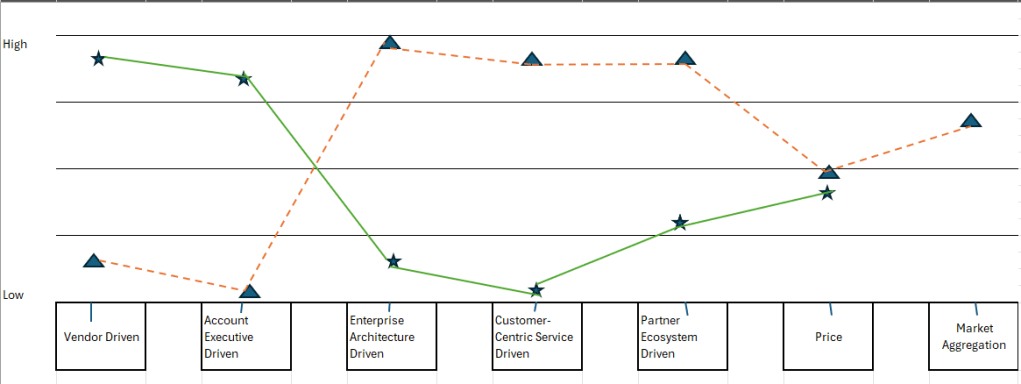
For each identified key factor, the management team swiftly and easily determined the desired “offering level” for customers. The green line in Graphic 1 represents BIT’s current strategy, with key factors on the horizontal axis and corresponding offering levels on the vertical axis.
What story does the green line of BIT’s current green line says?
BIT’s current strategy reveals a company heavily influenced by its IT vendors’ technological capabilities and financial incentives. The company’s success hinges on its account executives’ ability to acquire and retain customers, while its influence on customer IT strategy through enterprise architecture expertise is limited. BIT’s customer service team primarily focuses on day-to-day operations, and the company still relies on internal resources to provide IT solutions to specific market segments at competitive prices.
Strategy Canvas for the new BIT’s Strategy.
Following a well-deserved lunch break, the management team convened to discuss the new BIT strategy. Emma, who had previously done an excellent job of outlining the key challenge, led the discussion. She proposed a digital strategy for BIT that could not only be implemented internally but also offered as a value-added service to BIT customers. Additionally, Emma advocated for breaking down the siloed structure of the three business units.
What the red line of Graphic 1 says is that BIT’s core value is understanding a client’s unique business needs and providing tailored IT solutions. We avoid vendor lock-in by collaboratively designing and implementing the optimal IT architecture.
This requires a joint effort between our expert Enterprise Team and our Customer Service Team, ensuring direct client engagement.
To deliver such flexibility, we have to expand our network of service providers. This strategic approach maintains our competitive pricing and applies equally to both private and public sectors, eliminating the need for market segmentation.
In summary: Flexibility & Freedom – Tailored IT for Every Business.
Even if the market aggregation was a logical consequence of BIT’s core value, it required a quite effort for the management team to accept it as it goes against the standard marketing teaching. It help to hear from the facilitator that to build on powerful commonalities (aggregation) instead of focusing on customer differences (segmentation) is a powerful tool suggested by W. Chan Kim and Renée Mauborgne to achieve value innovation.
The Four Actions Framework and The Eliminate-Reduce-Raise-Create Grid.
To help the management team to build the new BIT Strategy line (the red line), the facilitator introduced
The Four Actions Framework.
When building a new strategy, there are four key questions to answer to challenge the current strategy line:
– which of the factors that the current strategy takes for granted should be eliminated?
– which factors should be reduced well below the current strategy levels?
– which factors should be raised well above the current strategy levels?
– which factors should be created that the current strategy is not offering?
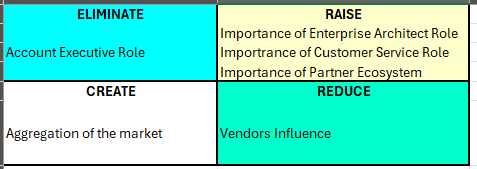
The Four Actions Framework brings naturally to the construction of the Eliminate-Reduce-Raise-Create Grid. This tools is another way to visualize the key elements of the new strategy (Picture 2).
The management team was ready to have the first feedback on the new strategic canvas from customers, competitors’ customers and noncustomers.

 QMS in Operations