The European Union Institutions (EUI) directly influence the creation of national public tenders through frameworks for public procurement, such as the Public Procurement Directives (Directive 2014/23/EU, Directive 2014/24/EU, and Directive 2014/25/EU).
Additionally, the tenders that EUI publish are often used as examples by national public administrations.
Therefore, it is valuable for a service manager to understand how the EUI contractually manages professional services contracts.
This post focus on the Quoted Time and Means Contract.
Author: paolobelotti
Understanding FIX PRICE Contracts in EUI Tenders.
The European Union Institutions (EUI) directly influence the creation of national public tenders through frameworks for public procurement, such as the Public Procurement Directives (Directive 2014/23/EU, Directive 2014/24/EU, and Directive 2014/25/EU).
Additionally, the tenders that EUI publish are often used as examples by national public administrations.
Therefore, it is valuable for a service manager to understand how the EUI contractually manages professional services contracts.
This post focus on the Fix Price type of contract.
Redefining BIT’s Strategy: A Collaborative Journey Through the Strategy Canvas
Phase A and Phase B of TOGAF pushed the whole BIT management to pay extra attention of review and communicate the strategy of the Company internally and externally.
As a result, the management agreed to incorporate the Strategy Canvas into the consolidated tools of SWAP analysis and Balanced Scorecard.
Understanding T&M Contracts in EUI Tenders.
The European Union Institutions (EUI) directly influence the creation of national public tenders through frameworks for public procurement, such as the Public Procurement Directives (Directive 2014/23/EU, Directive 2014/24/EU, and Directive 2014/25/EU).
Additionally, the tenders that EUI publish are often used as examples by national public administrations.
Therefore, it is valuable for a service manager to understand how the EUI contractually manages professional services contracts.
This post focus on the Time and Means type of contract.
From Quality Management to Strong IT Infrastructure: BIT Commitment to Best Practices with ISO 9001 and TOGAF.
It was time for BIT to introduce a framework for developing IT architecture aligned with ISO 9001 requirements: TOGAF.
Continue readingThe Secret Sauce of Best Practices: Start with WHY, Not How.
For EMMA (the new CEO of BIT) was quite clear “HOW” the ISO 9001 QMS can support BIT in his Digital Transformation journey.
During the talk with Paul (the quality coordinator of BIT) the subject of the mission and principles of BIT (the WHY) was touched.
As the highest leader of BIT, she knew that she needed to go deeper in understanding the link between the HOW and the WHY of BIT; it was time to invite Paul for another lunch (but this team in a Chinese restaurant).
How BIT Used ITIL Best Practices to Implement ISO 9001
The current CEO of BIT (Emma), was interested to understand how an ISO 9001 QMS introduced in the late 80’s could still be useful for the Company.
So, the question is how a “Norm” like ISO 9001 can exhibit such flexibility to accommodate the big changes of BIT over such an extended period of time? The secret to its resilience lies in its high-level approach, which empowers organizations to tailor it to their specific needs. In this post, we will explore how ISO 9001’s high-level framework has been a strength for businesses like BIT, emphasizing the importance of incorporating best practices into the norm.
Unraveling the Connection: A Q&A Journey on ISO 9001 in BIT’s Digital Transformation.
After speaking with HR, Finance and Services about Kanban method advantages for BIT, Paul was expecting to be called by Emma, the General Manager of BIT. The call arrived but he was surprised by the Outlook invitation content: I wish you explain to me how the current ISO 9001 system is helping (if any) BIT Digital Transformation”. You have one hour.
Continue readingUsing Cumulative Flow Diagrams to Analyze Process Stability in Kanban.
The concept of a stable process is not new to the BIT service team. In the Kanban method, the definition of stability is not based on the (quite difficult) concept of assumption of stationarity but on the more intuitive notion that the arrival rate of new work items and the departure rate of completed work items are (in average) equals.
However, the bottom-line message is the same: if the process is not stable (under control), you cannot make forecasts.
Practically, it is possible to understand if the process is stable through the analysis of a chart: the Cumulative Flow Diagram (CFD).
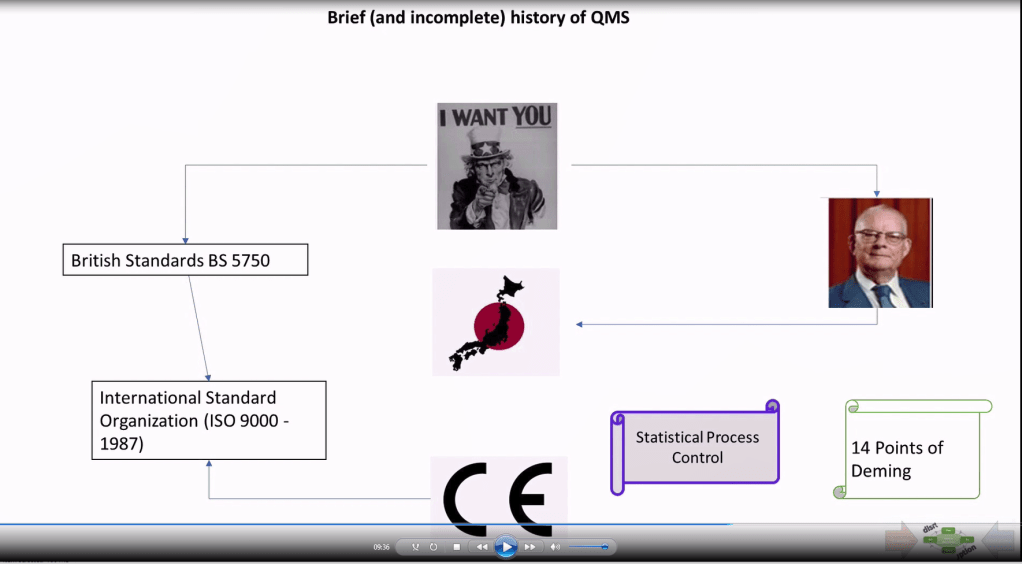
Brief (and incomplete) history of the QMS.
This short video (about 10 minutes) is dedicated to quality practitioners that didn’t have yet the time (or interest) to reflect why and where the approach to QMS was born and how it evolved with particular attention to the ISO approach.
 QMS in Operations